3D puff embroidery: what a machine can really sew
By BobbinBot. Published .
A machine sews 3D puff by stitching dense satin over foam, which stays inside and lifts the thread. That gives bold, rounded, raised shapes. It cannot sew the twisted-rope shading and glossy depth many AI mockups show.
What the AI mockups show
A popular kind of AI picture shows a cap with lettering that looks like thick, braided cord coiled into letters. Each strand has a bright highlight on top, a dark shadow underneath, and a smooth twist from one end to the other. The letters seem to stand well off the cap and catch the light like plastic.
These are pictures, made by an image generator. Nobody stitched them, and no stitch file is behind them. That matters, because a machine can only do what thread can do: lay one color of thread at a time, in rows, on top of the fabric or on top of something underneath it.
How 3D puff is really made
Puff embroidery puts a sheet of foam on the cap and sews a dense satin over it. The foam stays inside the stitches and holds them up, so the letters stand off the fabric with rounded tops. Tajima, a maker of commercial embroidery machines, describes the steps on its own site:
- The design sews an outline first, then stops so the foam can be placed.
- Running stitches tack the foam down.
- Satin stitches sew over the foam. A satin along the ends is sewn dense, at 0.2 mm spacing, to cut the foam at the edges.
- The foam outside the stitches is removed, and small remnants can be melted off with a hair dryer. Tajima warns that polyester thread can melt too if the heat gets too close.
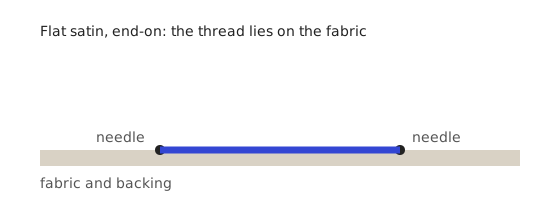
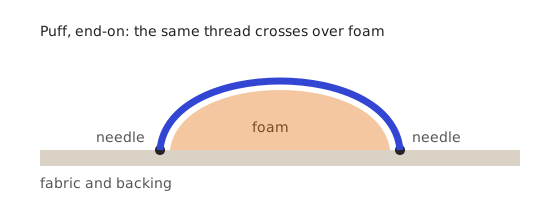
So puff is still satin stitching. The height comes from the foam, the roundness from the satin wrapping over it. Everything else about the look, the colors and the shine, comes from the thread itself.
What can and cannot be sewn
| In the mockup | Can a machine sew it? | Why |
|---|---|---|
| Raised, rounded letters | Yes, with foam | This is what puff is: satin over foam. |
| Bold, simple letter shapes | Yes | Wide satin columns cover the foam and cut it cleanly at the edges. |
| Thin raised lines and small details | Poorly | Every edge has to cover and cut the foam, which a thin stroke has little room for. |
| A braided or twisted rope in each stroke | Only as a suggestion | A satin column runs straight across its stroke. Two shades in separate narrow columns can hint at strands, but each stays flat on top. |
| Bright highlights and dark shadows painted on | No | Thread is one color per area. Its shine comes from the light in the room, not from the file. |
| Smooth gradients along a stroke | No | A stitch file changes color in steps, not gradually. |
| Lettering that covers the whole cap front | Not at that size | Our cap setting allows about 100 mm wide and 55 mm tall (config/items.json). |
See your mockup in flat thread colors
Upload the picture. The free simplify tool shows it in a few flat thread colors, the way a machine would sew it, and lists the threads.
What BobbinBot can and cannot do here
BobbinBot does not make puff files. Our engine writes flat stitches: running lines, satin columns from 1.5 to 7 mm wide, and fills, with the settings in config/thresholds.json. It has no stop for placing foam, no foam tack-down and no edge-cutting satin. We would rather say that than sell you a file that only looks like puff in a preview.
What it can do is the flat version of the same design: bold letters in two or three thread colors, sized to fit a cap, with a verdict before you pay. For the puff version, a digitizer who works with foam is the right person. Our cap size guide has the limits for the flat version.
Turning a mockup into something sewable
To see how a mockup looks once it is reduced to flat thread colors, run it through the simplify tool above. It shows the picture before and after, and lists the threads it would use.
- Pick one to three thread colors. Drop the highlights and shadows.
- Make the letters bold, with strokes several millimetres wide. Thin parts sew badly in puff and in flat satin alike.
- Simplify the shapes. A rope twist becomes a solid stroke.
- Size it for the cap: our cap setting is about 100 by 55 mm, with Tear-away cap backing.
- Decide flat or puff before anyone digitizes it. The two need different files.
- Sew a test on a spare cap before a batch.
Questions
Can a home embroidery machine do 3D puff?
It can sew satin over foam if the design was digitized for puff. You need puff foam and a file made for it, with a stop to place the foam.
Can I sew the rope look from an AI hat mockup?
Not as it is pictured. A machine can raise bold letters with foam, but the twisted strands, highlights and gradients in those pictures are painted, not stitched.
Does BobbinBot make 3D puff files?
No. Our engine makes flat embroidery only. It can make the flat version of a puff design, sized for a cap.
Why do thin letters fail in puff?
Because every edge of a puff shape has to cover and cut the foam. A thin stroke leaves too little satin to do that cleanly.
What happens to the foam after sewing?
The foam outside the stitches is removed. Tajima suggests melting small leftovers with a hair dryer, kept away from polyester thread.
How big can a puff design on a cap be?
That depends on the cap and the machine. For flat designs, our cap setting allows about 100 mm wide and 55 mm tall.
Sources
Related
Turn your picture into a stitch file
Upload a logo, a drawing or a name. You see the stitches and a green, yellow or red verdict before you pay, and every machine format comes in one download.